
CANADA · MEXICO · USA · JUNE 11 – JULY 19, 2026
FIFA World Cup 2026: The Complete Fan Guide to Schedule, Cities & Tickets
Everything you actually need to know about FIFA World Cup 2026 — explained in plain, simple language. No jargon, no confusion, just the facts every football fan is searching for right now.
🌎 3 host nations
🏟️ 16 stadiums
⚽ 48 teams
📅 104 matches
48
Teams Competing
12
Groups (A–L)
16
Host Cities
39
Days Of Football
Table of Contents
Why FIFA World Cup 2026 Is Different From Every World Cup Before It
Football fans have waited four long years for this moment, and now it is finally here. The FIFA World Cup 2026 kicked off on June 11 and will run all the way to July 19, spread across three countries at once — the United States, Mexico, and Canada. This has never happened before in the history of the tournament. Earlier World Cups were always held in one single country, or at most two.
This time, fans, players, and journalists are travelling across borders just to follow their favourite teams through the FIFA World Cup 2026 schedule, and that alone makes this edition feel like nothing we have seen before.
What makes the FIFA World Cup 2026 so special is its size. For the very first time, 48 national teams are taking part instead of the usual 32. That is sixteen more teams than the last edition in Qatar. More teams mean more matches, more surprises, more underdog stories, and more chances for smaller football nations to shine on the biggest stage of all.
Because of this expansion, the FIFA World Cup 2026 groups now include nations who have never tasted senior World Cup football before. Cape Verde, for example, qualified for a World Cup for the first time ever, and stories like this are exactly why this expanded format has captured so much attention.
If you are trying to follow the FIFA World Cup 2026 schedule, understand the FIFA World Cup 2026 groups, figure out which FIFA 2026 host cities you might want to visit, work out how the FIFA 2026 stadiums compare to one another, or simply want to know how to grab World Cup 2026 tickets before they sell out, this guide is written for you.
We have kept the language simple and avoided heavy football jargon, so whether you have followed football your whole life or you are completely new to the sport, you will be able to follow the entire FIFA World Cup 2026 schedule easily, from the opening kickoff to the final whistle.
Think of this article as your one-stop companion for the tournament. Instead of jumping between ten different websites to find the FIFA World Cup 2026 schedule, check the FIFA 2026 host cities, browse the FIFA World Cup 2026 groups, compare the FIFA 2026 stadiums, or search for trustworthy World Cup 2026 tickets, you can simply bookmark this page and come back to it throughout the tournament.
We will keep things conversational, skip the complicated football statistics jargon, and focus on exactly what casual fans and hardcore supporters alike are actually searching for.
Quick Fact
The FIFA World Cup 2026 is the 23rd edition of the men’s World Cup and the first one ever shared by three host nations at the same time, which is also why the FIFA World Cup 2026 schedule and the list of FIFA 2026 host cities both look so different from anything fans have followed before.
FIFA World Cup 2026 Schedule: Key Dates You Must Know
AI Generated Picture just for reference.
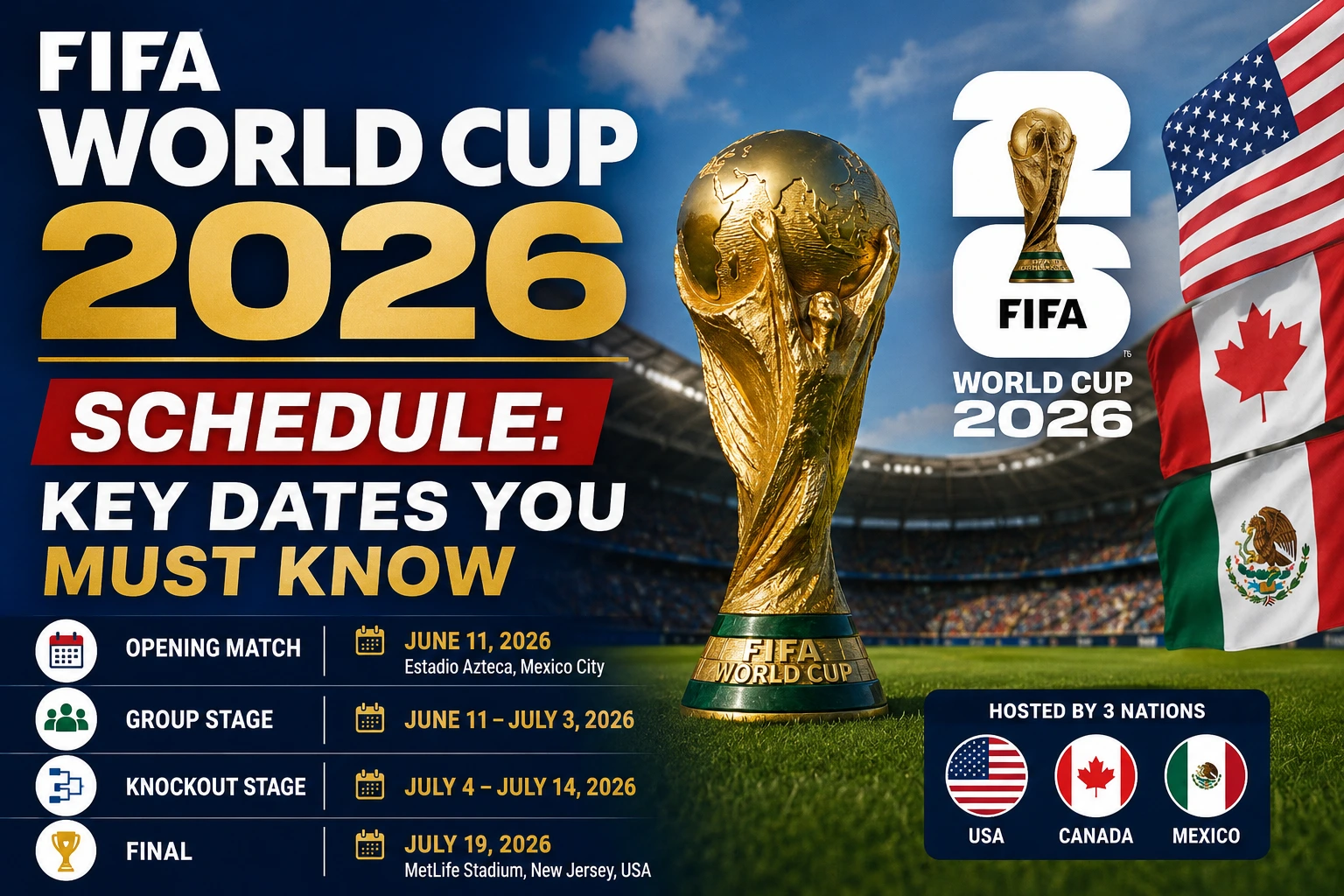
Let’s start with the basics. The full FIFA World Cup 2026 schedule covers 104 matches played over 39 days. That is a huge increase compared to the 64 matches played in previous tournaments.
The opening match was played on June 11 at the historic Estadio Azteca in Mexico City, where Mexico faced South Africa in front of a roaring home crowd. The tournament will close with the final on July 19 at the stadium in East Rutherford, New Jersey, just outside New York City.
Here is a simple breakdown of the major stages in the FIFA World Cup 2026 schedule so you always know what is happening and when.
Stage
Dates
What Happens
Group Stage
June 11 – June 27
All 48 teams play 3 matches each in their group
Round of 32
June 28 – July 3
Top teams and best third-place finishers battle to survive
Round of 16
July 4 – July 7
Knockout football begins to heat up
Quarter-Finals
July 9 – July 11
The last eight teams chase a semi-final spot
Semi-Finals
July 14 – July 15
Played in Dallas/Arlington and Atlanta
Third Place Match
July 18
The two losing semi-finalists play for bronze
Grand Final
July 19
New York/New Jersey hosts the biggest match in football
One thing that surprises a lot of fans about the FIFA World Cup 2026 schedule is just how long the group stage lasts. Because there are 48 teams now instead of 32, the early part of the tournament naturally takes more days to complete. So if you feel like the group stage is taking longer than usual this year, you are not imagining it — that is simply how the new and bigger format works.
The New 48-Team Format, Explained Simply
AI Generated Picture just for reference.
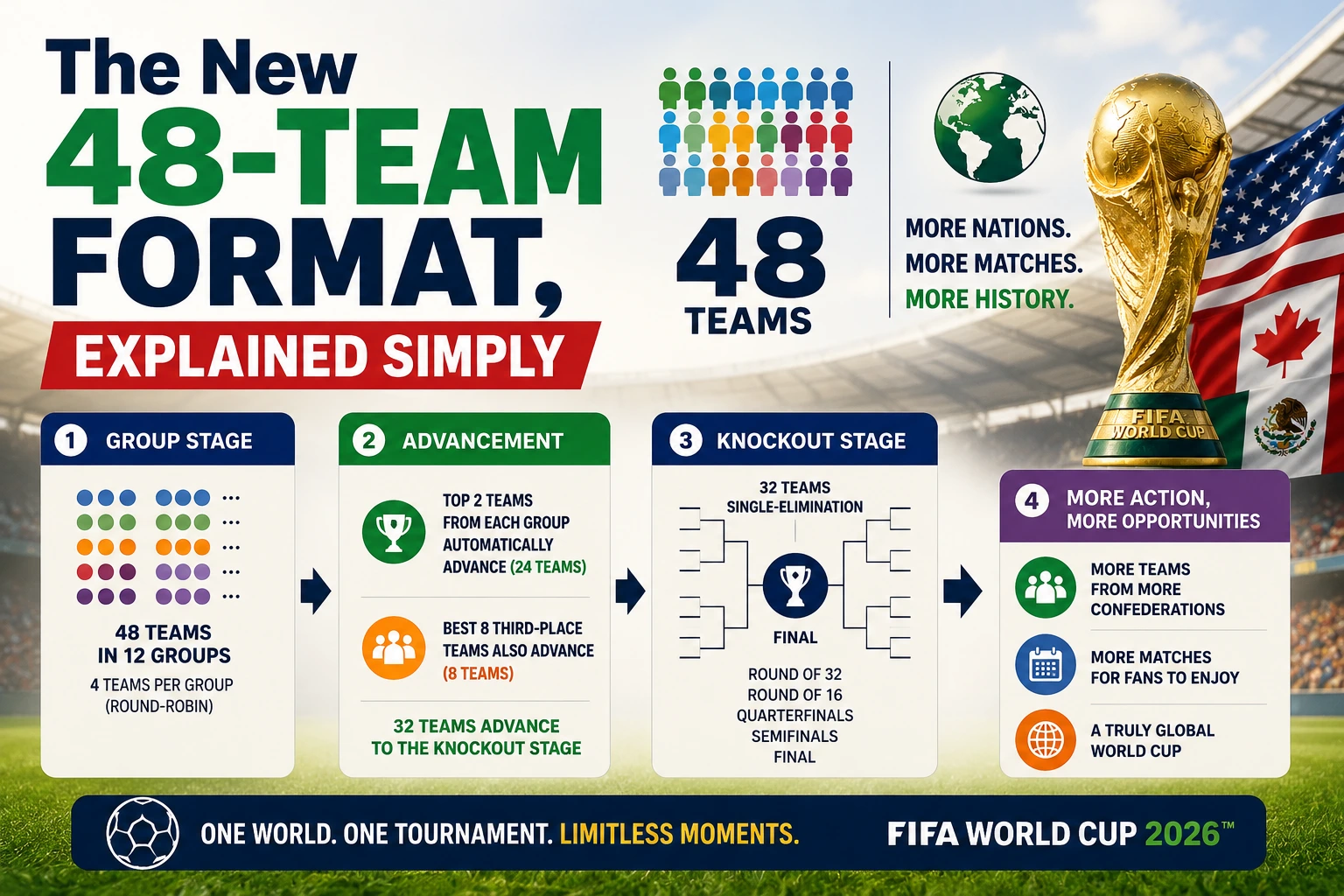
This is probably the biggest change in World Cup history, so let’s break it down in the simplest way possible. In the old format, there were 32 teams split into 8 groups of 4. The top two teams from each group moved forward, and the rest went home. Simple enough, right?
Now with 48 teams, FIFA had to come up with something new. At first, there were plans to use 16 groups of 3 teams each, but many people in football raised concerns. With only three teams in a group, the last match could sometimes be played in a way that benefited both teams unfairly, almost like a quiet agreement to share a result. FIFA listened to this criticism and changed course.
The final format settled on 12 groups of 4 teams, which keeps things fair, familiar, and exciting. Here is how it actually works in the FIFA World Cup 2026:
- Every team plays exactly three matches in the group stage, one against each team in its group.
- The top two teams from each of the 12 groups automatically move into the knockout rounds. That is 24 teams already through.
- The eight best third-place teams across all groups also get a second life and qualify for the next round.
- That gives a total of 32 teams advancing into the Round of 32, which is exactly the same number of teams that used to play the entire old-format World Cup.
- From there, it becomes straightforward knockout football. One loss, and you are out.
So in a way, the new format gives fans the best of both worlds. There are more teams, more matches, and more chances for underdog nations to qualify in the first place, but once the real knockout stage begins, it still feels like the classic World Cup everyone grew up watching.
“It mitigates the risk of collusion and ensures that all teams play a minimum of three matches while providing balanced rest time between competing teams,” — FIFA, explaining why the final 12-group format was chosen over the original plan.
FIFA World Cup 2026 Groups: Who Is Playing Who
The draw for the FIFA World Cup 2026 groups took place last December, and it placed all 48 qualified nations into 12 groups labelled A through L. Some groups turned out to be relatively gentle, while others are being called “groups of death” by fans and pundits because of how competitive they look on paper.
Host nations were placed carefully so they could stay close to home for as long as possible in the early rounds. The United States landed in Group D alongside Australia, Paraguay, and Turkey. Canada was drawn into Group B and will play all of its group matches on home soil, starting in Toronto before moving across to Vancouver. Mexico, as a host nation, opened the entire tournament in front of its own fans at the Estadio Azteca.
Without listing every single group line by line, here are a few storylines from the FIFA World Cup 2026 groups that fans are talking about the most right now:
- Group I features France going up against Senegal in an early heavyweight clash, alongside Norway and Iraq.
- Group J includes Argentina, the defending champions, who will be chasing back-to-back titles after their dramatic win four years ago.
- Group L brings England and Croatia together once again, a fixture that has produced unforgettable World Cup memories before.
- Smaller footballing nations like Cape Verde and Curaçao making their senior World Cup debuts have already become feel-good stories of this tournament.
If you want to follow live standings as the FIFA World Cup 2026 groups develop day by day, the official FIFA website updates tables after every single match, so you always know exactly where your team stands and what result they need next.
FIFA 2026 Host Cities: A Tour Across Three Countries
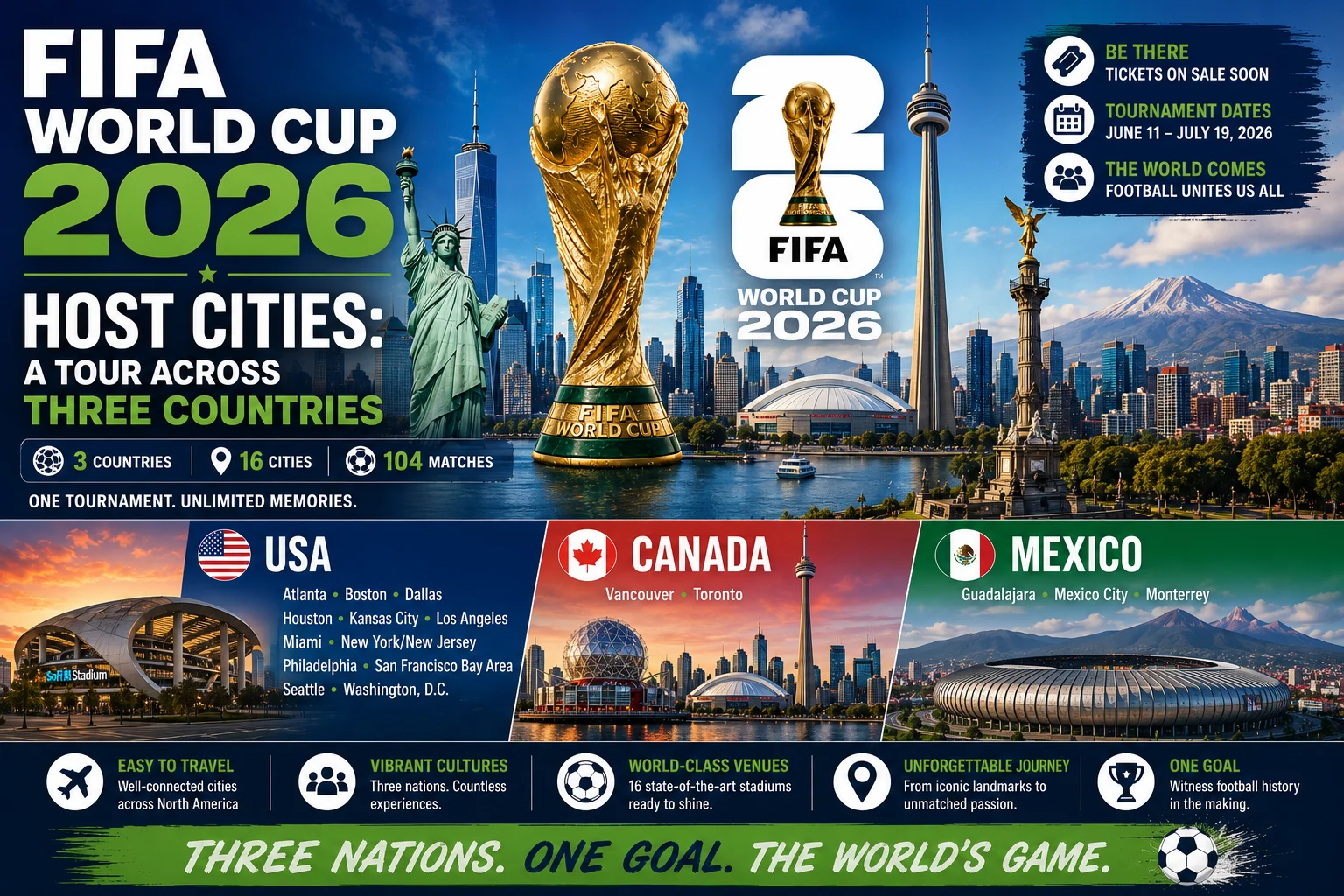
One of the coolest parts of this tournament is just how spread out it is. There are 16 FIFA 2026 host cities in total — eleven across the United States, three in Mexico, and two in Canada. Each city brings its own personality, food, culture, and football history to the tournament, which makes following along even more fun for fans at home.
Here is a simple look at the FIFA 2026 host cities and what makes each one worth knowing about.
AI Generated Picture just for reference.
🇲🇽
Mexico City
Home of the legendary Estadio Azteca, now the first stadium ever to host matches across three different World Cups.
🇺🇸
Dallas / Arlington
AT&T Stadium is the largest venue of the tournament and stages a record nine matches, including a semi-final.
🇺🇸
New York / New Jersey
MetLife Stadium hosts the grand final on July 19, the closing chapter of the entire competition.
🇨🇦
Toronto
One of two Canadian host cities, staging Canada's opening group matches in front of passionate home fans.
🇨🇦
Vancouver
BC Place gives Canada's west coast its first-ever taste of senior men's World Cup football.
🇺🇸
Atlanta
Mercedes-Benz Stadium stages the second semi-final along with several high-profile group matches.
🇺🇸
Los Angeles
SoFi Stadium hosts a packed slate of matches including a quarter-final on the west coast.
🇺🇸
Seattle
Lumen Field offers one of the most scenic settings of the tournament with downtown skyline views.
🇲🇽
Guadalajara
A true football city in Mexico's heartland hosting several group stage fixtures throughout June.
Whether you are planning an actual trip or simply following from your couch, knowing the FIFA 2026 host cities helps you understand travel patterns for teams, why certain matches kick off at unusual hours, and how fans are experiencing this tournament across such a massive footprint of land.
FIFA 2026 Stadiums: Old Giants Meet Modern Marvels
AI Generated Picture just for reference.
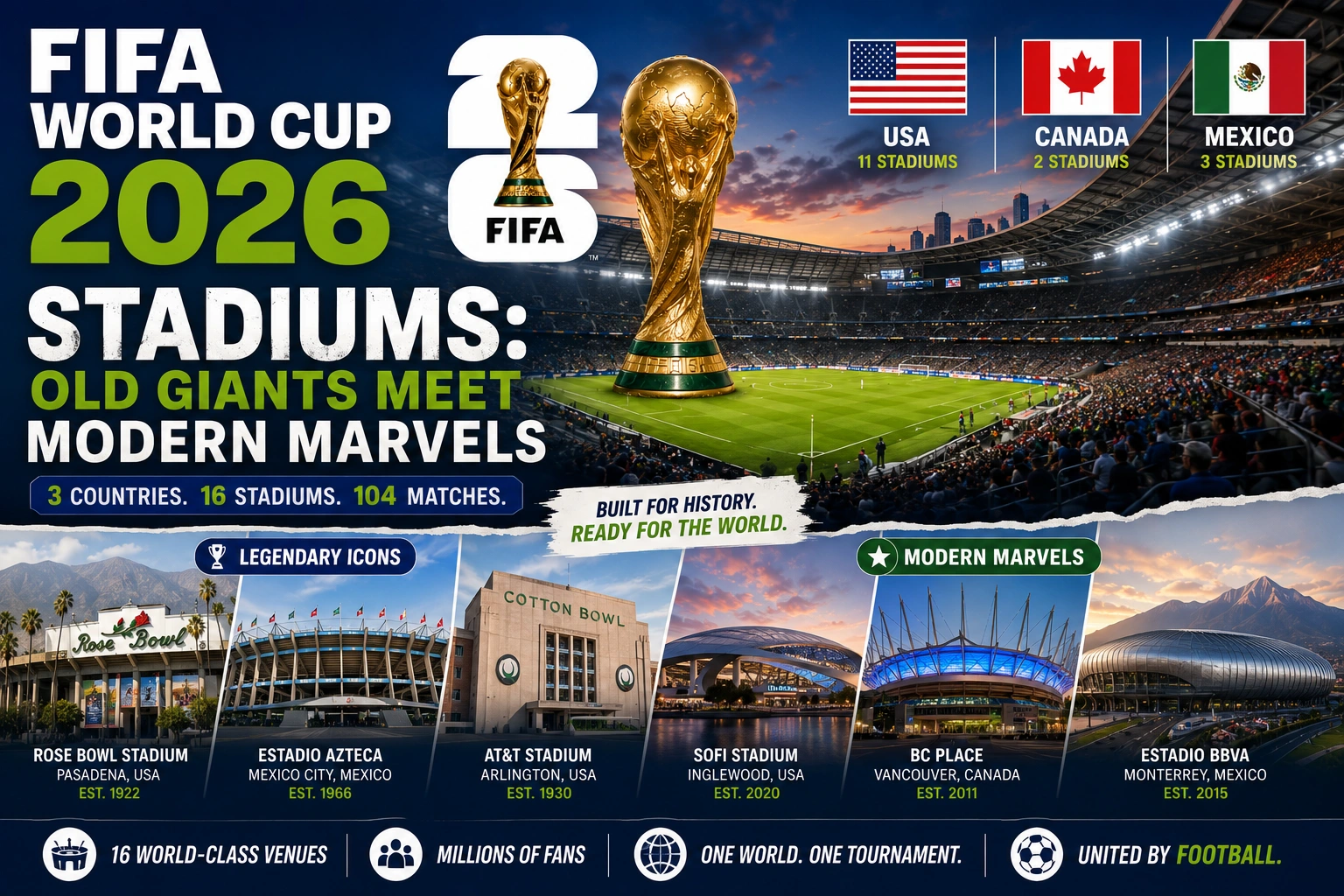
The FIFA 2026 stadiums chosen for this tournament range from century-old football cathedrals to brand-new, ultra-modern arenas. This mix is part of what makes the tournament feel so unique compared to past editions.
The Estadio Azteca in Mexico City deserves special mention. It already hosted the World Cup finals in 1970 and 1986, and now becomes the very first stadium in football history to host matches across three separate World Cups. Walking into a venue with that much history is something fans have been dreaming about for years.
On the other end of the spectrum, AT&T Stadium in the Dallas area represents the modern face of American football infrastructure. With a seating capacity close to 94,000, it stands as the biggest venue of the tournament and is hosting more matches than any other stadium, including one of the two semi-finals.
Here is a quick snapshot comparing a few of the standout FIFA 2026 stadiums by approximate capacity:
Stadium
City
Approx. Capacity
Notable Match
AT&T Stadium
Dallas / Arlington, USA
~94,000
Semi-Final
MetLife Stadium
New York / New Jersey, USA
~82,500
Final
Mercedes-Benz Stadium
Atlanta, USA
~75,000
Semi-Final
Estadio Azteca
Mexico City, Mexico
~83,000
Opening Match
Lumen Field
Seattle, USA
~69,000
Round of 32
Each of the FIFA 2026 stadiums has its own atmosphere, food culture, and fan traditions, so even watching from home, it is worth paying attention to where each big match is being played. The setting genuinely changes how a match feels on television.
World Cup 2026 Tickets: What Fans Need To Know
If you are hoping to attend a match in person, getting World Cup 2026 tickets the right way matters a lot. FIFA sells official tickets directly through its website and authorised partners, and these are released in different sales phases, often through random draws rather than a simple first-come, first-served system.
Here are a few practical tips for anyone chasing World Cup 2026 tickets:
- Always buy from official sources. The only guaranteed safe way to buy World Cup 2026 tickets is through FIFA’s official platform or its officially licensed hospitality partners.
- Be careful of resale sites. Plenty of third-party platforms claim to sell genuine World Cup 2026 tickets, but unofficial resale carries real risk of fake tickets or simply being denied entry at the gate.
- Group matches are usually easier to get than knockout games. If your dream is the final or a semi-final, expect prices and demand to be extremely high, since these are the most sought-after World Cup 2026 tickets of the entire event.
- Factor in travel costs separately. Because FIFA 2026 host cities are spread across three different countries, flights, visas, and accommodation often end up costing more than the ticket itself.
- Keep an eye on official FIFA announcements. Extra batches of World Cup 2026 tickets are sometimes released closer to match dates, so it pays to check back regularly instead of assuming everything sold out.
Even if attending in person is not realistic for you, simply understanding how the ticketing system works helps make sense of stadium attendance numbers, secondary market pricing news, and why certain matches feel like once-in-a-lifetime events.
Met Gala 2026: Theme, Best Dressed Celebrities, Viral Moments & Complete Breakdown
Teams And Players Everyone Is Talking About
With 48 nations involved, there is no shortage of storylines this summer. Argentina arrived as defending champions, looking to defend the title they won so dramatically in the previous tournament. Many fans are watching closely to see whether the squad can go back-to-back, something only a handful of nations have ever managed in World Cup history.
On the individual side, a new generation of superstars has taken centre stage. Young attacking talents have already been scoring freely in the opening matches, while more experienced veterans are using what could be their final World Cup appearance to chase one last piece of glory.
Beyond the traditional football powers, this expanded tournament has given a real platform to nations who rarely get this kind of spotlight. Debut appearances and surprise results in the group stage have already reminded everyone why football is called the world’s game — talent and passion for this sport exist absolutely everywhere, not just in the usual handful of countries.
Top Modeling Agencies 2026: Ultimate Guide to Fashion Modeling Agencies Worldwide
Did You Know?
This tournament features several countries making their senior World Cup debut for the very first time, a direct result of the expanded 48-team format opening doors that simply did not exist before.
How To Watch Every FIFA World Cup 2026 Match
With 104 matches to follow, knowing where to watch is just as important as knowing the schedule. Broadcast rights for the FIFA World Cup 2026 vary by country, so the right channel or streaming app depends entirely on where you are located.
In general, official broadcasters and their streaming platforms carry full live coverage of every single match, often with additional analysis shows, highlight packages, and replay access. Streaming has become a major part of how fans follow football today, so even people without traditional television access usually have a legal way to watch every match live through an official app.
A few simple tips to make sure you never miss a match:
- Check your country’s official broadcaster as early as possible, since rights can sometimes be split between two or three different networks.
- Download the relevant streaming app ahead of time and create your account early, rather than scrambling minutes before kickoff.
- Keep a separate note of match times in your own local time zone, since FIFA 2026 host cities span several different time zones across North America.
- Set reminders for knockout matches in particular, as these tend to draw the heaviest streaming traffic and can occasionally suffer from buffering if you join right at kickoff.
Travel Tips For Fans Heading To North America
For fans planning to travel between FIFA 2026 host cities, a little preparation goes a long way. Because the tournament spans three countries, simple things like currency, time zones, and even electrical plug types change as you move around.
- Sort your travel documents early. Crossing between the United States, Mexico, and Canada may require different visas or entry permits depending on your nationality, so check requirements months in advance.
- Book accommodation as early as possible. Hotel prices in FIFA 2026 host cities tend to rise sharply close to match dates, especially in cities hosting marquee fixtures.
- Plan transport between cities carefully. Some FIFA 2026 host cities are a short flight apart, while others involve much longer travel, so build buffer days into your itinerary rather than cutting it close.
- Pack for varied weather. June and July bring very different climates across this footprint, from humid southern cities to milder conditions in the Pacific Northwest and Canada.
- Learn a few local phrases. Even basic Spanish in Mexico or simple courtesies in any host city go a long way in making your trip smoother and friendlier.
Whether you are chasing a single match or building an entire summer trip around the tournament, a little planning turns a good World Cup experience into an unforgettable one.
Final Thoughts On The FIFA World Cup 2026
The FIFA World Cup 2026 is shaping up to be one of the most memorable editions of the tournament in its long history, and not just because of its size. There is something genuinely special about watching football’s biggest stage stretch across an entire continent, connecting fans in Mexico City, Toronto, Seattle, and New Jersey through one shared love of the game.
Whether you are tracking the FIFA World Cup 2026 schedule day by day, planning a trip to one of the FIFA 2026 host cities, trying to secure World Cup 2026 tickets, or simply following the FIFA World Cup 2026 groups from your living room, this tournament has something for every kind of fan. New stars are emerging, old rivalries are being renewed, and underdog nations are writing their own unforgettable chapters.
Bookmark this guide, keep checking back for updates as the knockout rounds approach, and most importantly — enjoy the football. This is exactly the kind of World Cup people will be talking about for decades to come.
Frequently Asked Questions
How many teams are playing in the FIFA World Cup 2026?
A total of 48 national teams are competing, which is the largest field in World Cup history and a big jump from the 32 teams used in every tournament since 1998.
Which countries are hosting the FIFA World Cup 2026?
The tournament is jointly hosted by the United States, Mexico, and Canada, marking the first time in history that three nations have shared hosting duties for a men’s World Cup.
How many FIFA 2026 host cities are there?
There are 16 FIFA 2026 host cities in total — eleven in the United States, three in Mexico, and two in Canada — each with its own dedicated stadium.
When does the FIFA World Cup 2026 final take place?
The final is scheduled for July 19, 2026, and will be played at the stadium in East Rutherford, New Jersey, just outside New York City.
Where can I buy genuine World Cup 2026 tickets?
How does the new 48-team format actually work?
Teams are split into 12 groups of four. The top two from each group advance automatically, and the eight best third-place teams also qualify, bringing the knockout stage to a familiar 32 teams.
Why is this tournament called the biggest World Cup ever?
Between the record 48 teams, 104 total matches, 16 host cities, and three host nations, this edition is larger in nearly every measurable way compared to any previous FIFA World Cup.
Latest Posts



T
TopModelsBio Editorial Team
Fashion & Biography Experts
Our editorial team specializes in fashion industry research, model biographies, and agency guides. We update all content weekly to ensure you always have the most accurate and current information about the global fashion industry.
Zeeshan Shaikh
Author